
From unclear job roles to contaminated cleaning cupboards, Kelsey Hargreaves, technical manager at BICSc, explores the hidden challenges for improvement in healthcare cleaning
In my first few months of really working within the cleaning industry, I was in a place where using the words ‘infection control’ came as naturally as breathing. It seemed so amazing and official to me to be able to say those words. I wasn’t a nurse or a doctor, I was in the cleaning team, and yet I was able to share stories of infection risks and best practices for ‘infection control’.
It took me a while to grasp the breadth of everything that was involved. And I think if we are all being honest, many parts of infection control are still unbeknownst to us, how deep we can go with it, classify a control measure, a risk and especially how to execute it fully.
Infection control is often discussed in terms of visible actions – disinfecting surfaces, wearing gloves, using approved chemicals, and washing our hands. But beneath these surface-level practices lies a complex web of control mechanisms that determine whether our actions are truly effective in preventing the spread of infection.
In this article, I’m going to refer to the cleaning side of infection control, but the hidden dimensions of control that we often don’t talk about. A look at common practices or in practices that I have seen time and time again, that we all seem to bury our heads in the sand over and pretend it doesn’t happen.
Defined job roles
The worst and most overlooked infection control risk, in my humble opinion, is the lack of transparency, clarity, understanding and standardisation of job roles. I often joke about the age-old question: “To clean blood or not to clean blood,” but it is a stark reminder of a real issue within healthcare cleaning.
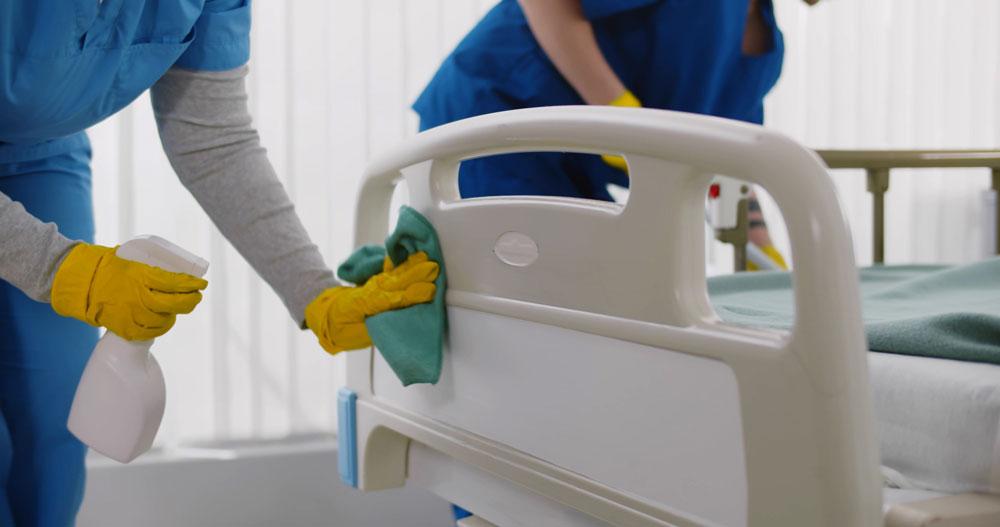
You are lucky if there is specification or a scope that dictates who should do what task and who is responsible for things like changing bed linen, handling bodily fluids; and cleaning blood spills. These tasks often fall under clinical or specialist roles, yet in practice, they are often delegated informally or expected of the “cleaning staff” by those who do not want to spend time doing them. This blurring of responsibilities introduces risk, especially when operatives are not trained or equipped for such tasks. Standardising job descriptions and enforcing boundaries is essential to ensure that infection control protocols are followed correctly.
Additionally, many organisations confuse cleaning processes (the how) with cleaning elements (the what). For example, a checklist might include “clean the floor,” but not specify whether it involves bodily fluid contamination, which requires a different protocol. This lack of specificity can lead to inconsistent practices and increased infection risk. Develop process-specific protocols that clearly differentiate between routine cleaning and infection-related interventions.
All this ambiguity can lead to delayed responses or improper cleaning, both of which compromise infection control. Organisations must establish clear, written protocols for handling biohazards, including: who is responsible; what PPE is required; what cleaning agents are approved; and how waste should be disposed of.
Uniforms
Outside of the healthcare environment, uniforms are often seen as protective, but they can also be vectors of contamination if not managed properly. I remember the shocks and choir of gasps that myself and Denise, commercial director of BICSc, received when we changed into our uniforms at work before commencing training and changed back out of them, washed ourselves and bagged/sealed the uniforms before leaving.
Why wouldn’t we? Why aren’t we considering the cycle of our workwear as an IPC risk? Think about what we could take home to our loved ones, and think about what we could bring into spaces where others have loved ones? Another feature of the everyday that without proper management could have catastrophic results.
In any organisation, the ad-hoc request is often one filled with the most risks – cleaning is no different. Bypassing formal protocols often leads to sustained malpractice, untrained operatives completing the task quickly and improper risk assessments of the job that needs to be done.
Cleaning cupboard cross-contamination
Furthermore, there are problems with not just the clothes on our backs, but what we bring with us to work: CCCC – Cleaning cupboard cross-contamination.
Think of the average cleaning cupboard – what does it have in it? Mops, cloths, vacuums… what else? As much as it pains me to say it, other common features of a cleaning cupboard are: jackets, coffee mugs, shoes, hairbrushes, today’s lunch, or last week’s?
Cleaning cupboards are often used to store everything, from chemicals to personal items. This creates a high-risk environment for cross-contamination. The best advice that I can give is that we should be treating cleaning cupboards like preparation rooms for theatres. It should have only the equipment we need to perform the tasks we need to do. It should be kept tidy, clean and decontaminated after use. If it is in the cleaning cupboard, it is to be used to aid cleaning, not to be used to brush one’s hair, or hold a cup of tea.
To help this become a zone of control and not a source of contamination, companies should: provide individual
lockers for personal items; separate chemical storage from equipment storage; regularly audit storage areas for compliance and remove unnecessary items; and provide separate spaces for lunch.
Staff wellbeing
Another often overlooked aspect is the psychological safety of cleaning staff. When operatives feel empowered to speak up about unsafe practices or unclear instructions, infection control improves. Creating a culture where feedback is welcomed and acted upon can lead to better adherence to protocols and a stronger sense of responsibility among staff. This cultural shift requires leadership commitment and consistent reinforcement.
All these changes come with time, even with protocols in place, infection control fails without ongoing training and reinforcement.
So is lack of reinforcement, lack of training and lack of assurance an infection control risk? Absolutely.
I can honestly say that I have received no formal infection control training, but I have received training that has helped me understand the most important parts of control and allows me to be dynamic in my assessment of IPC risks.
True infection control in cleaning is not just about disinfectants and mops – it’s about control systems, role clarity, infrastructure, and culture. By addressing the hidden layers of control and standardisation, organisations can transform cleaning from a routine task into a frontline defence against infection.
When we focus on these hidden layers of control, we move beyond surface-level hygiene. We create environments where cleaning is not just reactive, but proactive. Not just routine, but strategic. And in doing so, we protect not just spaces, but people.